The Rise of Esports: Careers, Competition and Global Growth: Sir Paul J. Foster on why gaming’s most influential era is still ahead
“The future contributors to GDP are gaming now.”
By Jude Ower
“The future contributors to GDP are gaming now.” That is the message from Sir Paul J. Foster, President & Chief Executive Officer of the Global Esports Federation, who believes esports is entering a new phase of commercial maturity, creating significant opportunities for national economies, international investment and future careers.
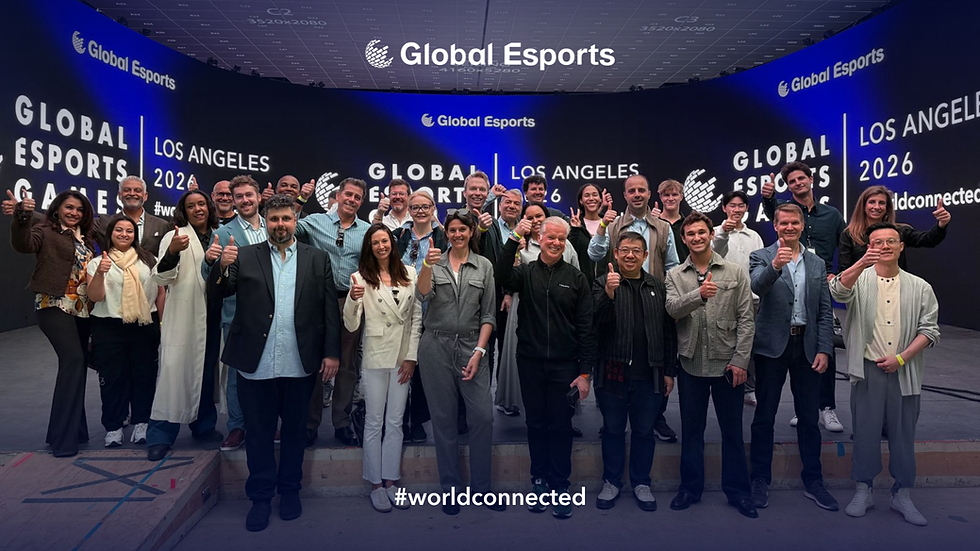
Having spent 25 years in the Olympic movement, including working on 14 Olympic Games, Sir Paul brings a distinctive perspective to esports' growing global influence. Today, the Global Esports Federation has 181 Member Federations, with the Global Esports Games heading to Los Angeles in early December 2026, ahead of the city's 2028 Olympic Games.
But Sir Paul's vision extends beyond elite competition and economic growth. He sees esports as a platform for developing skills, connecting communities and mobilising people around social causes. He also believes the industry must move beyond outdated stereotypes and focus on translating innovation into tangible impact.
During our conversation, which was recorded at Gamescom 2026, Sir Paul and I discuss the convergence of sport, technology and youth culture, the growing recognition of esports among governments and businesses, and why the industry's next chapter could be its most influential yet.
This interview with Sir Paul J. Foster – hosted by Jude Ower - has been edited and condensed from the original Good Game Club podcast for length and clarity.
Can you introduce yourself and explain what the Federation is all about?
I grew up in Sydney in Australia, and then I spent 25 years in the Olympic movement. I worked on the Sydney Olympic Games in 2000 and spent the next 25 years working across the Olympic movement, including some time at the IOC in Lausanne, Switzerland. I got to produce 14 Olympic Games, which is a huge undertaking. And then one day the phone rang, and it was all around esports and it was in 2018. And we flew to Singapore and got out a notepad and said, if we built something called the Global Esports Federation, what would it look like?
We went to our roots in the Olympic movement and thought, how would we structure it? What would we think about? How would we build it? And it was at that very sort of pivotal moment. Of course, we didn't know that the pandemic was coming just a few months later, and we launched our first ever Global Esports Games in Singapore. And we went from there to Istanbul and from Istanbul to Riyadh and from Riyadh to Mumbai.
And in December this year we will be in Los Angeles, where we're headquartered in the United States. We're heading towards our seventh year, and we have 181 Member Federations. And as you know, Jude, approaching 4 billion gamers in esports. So, we're a very large community.
Coming from the Olympics and a traditional sports background, what convinced you that esports was a sport?
I really spent time talking to our community and listening to our community, and I quickly realized that those definitions didn't really matter. But some folks in traditional sport and government and industry needed certain definitions. They needed to know, is it a sport? Is it not a sport?
What we did very early on was to think, instead of governing the sport, like FIFA, for example, governs football or soccer. We thought about, how could we manage or how could we help to coordinate this community, this industry that's sometimes regarded as very fractured or splintered or separated. And we actually thought of that as a superpower. So instead of governing it, we talked about convening.
We really thought about what could we do to bring our expertise and experience to convene all these individual parts of what is an incredible and a very wide community into something very powerful. To give it a little bit of - I wouldn't use the word structure - but to give it a little bit of a framework that could let the wider community understand what it was. This was very important because this allowed commercial partners and publishers and developers and universities and other sort of stakeholders to participate as well.
What would surprise people who don’t know about esports, what would surprise them about the athletes who are behind the sport?
I always say that the definition I use for esports is four words: organized professional video games. When we play a video game, we're playing a video game, and we do it in an organized, professional, competitive format. It could be called esports.
And oftentimes, folks might consider that esports is one single definition. And of course, the great thing I like about esports and gaming is that there's something for everyone. Some people like to play games, some people like to watch, some people like to hear the backstories. Some people like to see the great things around sport, which is the struggle of winning and the disappointment in not winning and those sort of very human things around sport.
What do you think competing for your country at global esports does for a young person?
I remember very distinctly talking to a great tennis icon, Roger Federer, around it. He said, when I get to compete for my country under the flag, there is nothing more important. There's no prize money. But I get to compete for my country, and that's the most important thing I could do. And that's been the same for our community. When you get a chance to represent your country. Because, of course, there's a sense of national pride, but there's also a sense of responsibility and role model and the pressure that that has at the elite level.
And just that chance to shine that maybe they wouldn't have had in any other way because they love playing games and they can do it at the highest level and then represent their nation and really become part of history. I've been very honoured to be able to witness that first-hand, to see the impact that that responsibility, that pride can have, not just on single individuals, but on communities, on regions and on nations. I think it’s very powerful.
Part of what we’re trying to do here is challenge misconceptions about the industry. And I think there’s many misconceptions about esports. What does esports do for players’ well-being or health or fitness?
It teaches strategy, teamwork, thinking, preparation, focus. And oftentimes when I get asked the question, is it a sport? They’re the things that I'll talk about - the preparation, the skill, the agility, the mental focus, the strategy, the teamwork, the ability to communicate, the ability to keep composure and to be a good winner and a good loser. And to improve, I guess, is that there's this sense of measurability, the fact that in esports and gaming you can really measure it. It's very visible.
The thing that I would say is that there really is an opportunity for you to find the place and space that you feel most comfortable in and then to have a lot of fun. One of the things that we're starting to think about is that we really believe that talent everywhere should have opportunities everywhere. This notion of creating the most inclusive platforms we can, the most participation we can, the most events around the world that we can and the most forms of consuming that as we can. That's something we're thinking about a lot. The distribution of content.
When you look at esports, you think about the players, the athletes and the opportunity that opens up to the people who play. But then it goes beyond that, the jobs, the community, the skills. What other opportunities can come out of esports as a career path?
We're definitely entering this phase of maturity of the cycle. There's a maturity coming into the business, into the community, at the national level. And with that, I think, not just gaming and esports, but also industry and business and commercial partners and distribution partners are taking that very seriously. And there's a real economic upside to that.
I was privileged to be at the World Government Summit this year in Dubai. And part of our panel, what I talked about is that the future contributors to the GDP of your individual countries are gaming now. I think that's something very real that governments are really looking at, and you see that all across the world.
Where do you see play as a force for good or social impact?
The beautiful thing about esports and gaming is because it's 24-7, 365, as you said before, Jude, it's super democratic in the sense that it's wide ranging. It's accessible to many people. Unfortunately, it's still not accessible to everybody and we need to work on that. That's probably the key point about social impact.
At the Global Esports Federation, we prioritize our global social impact initiatives. On the margins of the Paris 2024 Olympic Games, a couple of years ago, we launched an incredible program called our global social impact partners and our program we did with UNESCO. And we identified several of the United Nations Sustainable Development Goals to focus on. And we decided to focus really in and around education, health and wellbeing and financial services.
But in terms of impact, what's fascinating, just because of the nature of our community, being digital first and being digital native and being highly aware of digital conditions, it gives us an incredible vehicle for our impact partners, including the United Nations system and the Olympic Movement and others that need our help and need our voice to immediately access them and ask for help.
Gamers really care, they really mobilise, they want to do good. They care about world issues, and if they can take action while they play, then it means a lot to them.
I think one of the challenges for all of us in our roles is to get the messaging right, if that makes sense. And I think that's where I spend a lot of my time and our team spends a lot of time, is how frequently to communicate, how do we communicate, word choice, image choice, ask.
One of the things that's great about the community is that the feedback comes fast, unfiltered, honest. And it's up to, I think, management and leadership to sort of interpret that and stay aware of that trend. It's moving fast. And even in the six years that we've been at it, it's changed 180 degrees. That’s exciting. Some might say it's exhausting, but it's exhilarating.
It's about finding that right narrative, using the right vocabulary that goes beyond the industry, working with government, working with NGOs, working with partners beyond the industry. We have to have that shared common language that we can use in non-gaming terminology to help others.
We're in a highly visible environment. I mean, esports and gaming is highly visible. It's highly emotive. It's highly sensory. One of the things that the community teaches us is this openness and inclusivity. And that's something I like to think about how we can be more inclusive, how we can be more what we call radical inclusivity, like actively being inclusive.
When I think about our community coming together at the Global Esports Games in Los Angeles in December, the first week of December, for me at least it’ll be the 115 national flags that will be present. It will be that sense of grandeur, the pride, in the case of LA, we're heading two years to the Olympic Games in Los Angeles in 2028. We've just come off the FIFA World Cup, the Super Bowl next year. So, esports is now in those environments. So that's pretty cool.
How do you see the future, what are we building for the next billion gamers?
We talk about the 4 billion gamers and we think about, well, what about the next 4 billion gamers? We're certainly seeing mobile gaming. We're certainly seeing wider range. We're seeing new cities wanting to host our IP and our tournaments that would have never considered hosting them before.
Our first-ever Global Esports Cup will be staged in Africa next year. And that's a great example, I think the 54 countries of Africa have hosted events, but never at that sort of level.
I believe that we're looking at it from a lens of entertainment. But it's also got to have that flavour of individuality. At a certain moment, you have to make a decision to move on how you're going to shape and curate that event and what it's going to have. You will definitely come under criticism and you will not be able to make everyone happy.
You said you will come under criticism and you can’t keep everyone happy, how do you manage that?
I learned to celebrate that. Of course, it's much nicer to be told that you're doing a great job and everything's perfect. I personally need more than that. I think that that's too easy to say.
We're not perfect, and I think we've sort of given up on needing to be perfect. I think perfect is perhaps a fallacy in terms of aspiration.
I'd rather be known for being a good communicator, being dynamic, being open to change, being open to listen, being open to make decisions, and not being obsessed about being perfect. There's certainly a base level requirement of creating the conditions so that athletes can shine and excel and do their very best. And this notion we have at our place called shine light, create space and move out of the way.
I think creating the forums where you can welcome different voices, not always the loudest voices in the room, create conditions that let the quieter voices be heard. I think our job in leadership is to create the environments that not only welcome that but encourage that. And the format for those suggestions and those considerations should be something that I think leaders should think about.
What do you think the industry needs to do to rid itself of its own negative stereotypes of itself?
You just need to put a plan in action and get on with it, really. I think the stereotypes, by definition, are stereotypes. I think that's changed. And I think, to be very frank, the more we talk about the stereotypes and talk about it, the more air and oxygen we get into that. The industry is maturing. I mean, I want to give my hats off to the industry. I think that it's come a long way in really hard conditions.
We were thrown a pandemic. We were thrown new technologies. Esports and gamers have always been the first adopters of technology. We knew about AI, we were using it in gameplay. They're a very resilient group. And you'll find that within the group, they don't often talk about stereotypes. I think when maturity occurs, commercialization occurs.
We're living in probably the most exciting time in the history of our community and our industry because of the convergence of sport, esports, technology and youth culture - the understanding at the government level, at the commercial level, at the distribution level, at the community level, not just of the super powerful nations, but of every nation on the planet; and we are literally in that moment where we're getting to influence that and create space for that.
And it requires all of us in any role of contribution to really get on with it and make a plan and make an impact and just move it forward.
Watch or listen to the full conversation with Sir Paul J. Foster on the Good Game Club podcast here Good Game Club Podcast - YouTube.